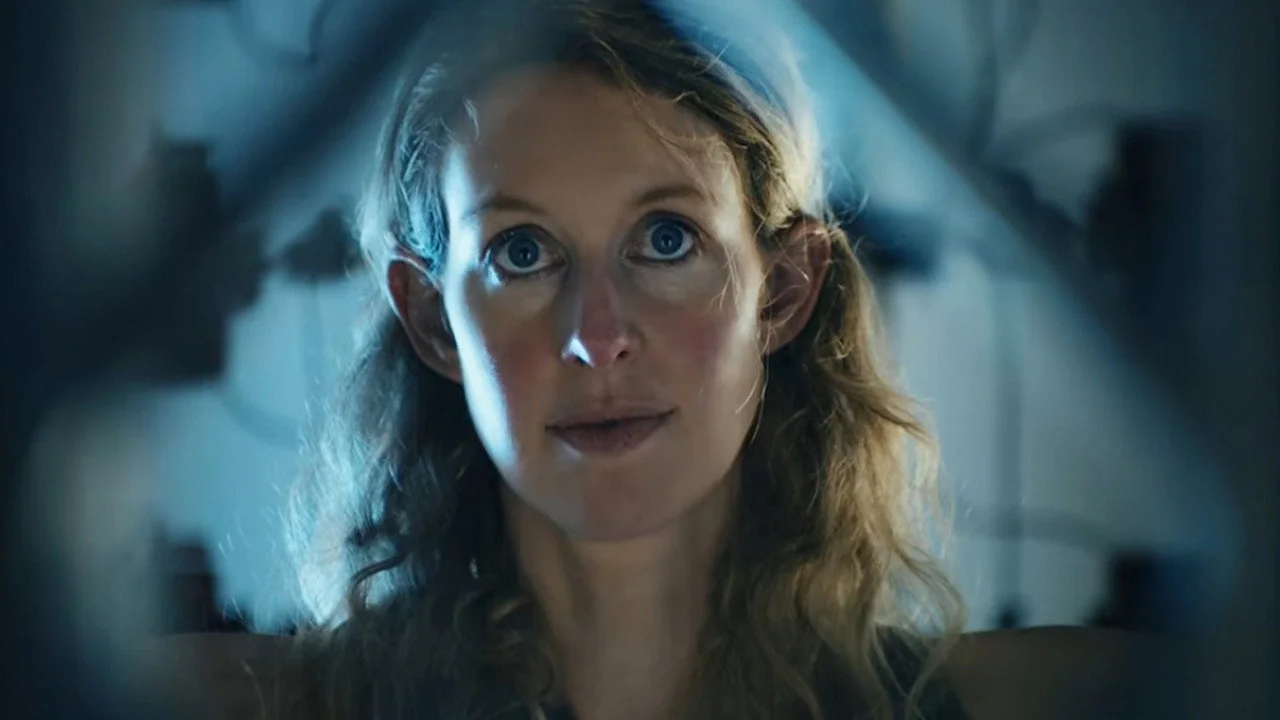
Elizabeth Holmes being filmed to create a 3D AI avatar of her.
Everyone who walks out of You Can See Everything has the same questions. Is Elizabeth Holmes for real? On the autism spectrum? Or is she just an evil genius?
The film brilliantly leaves it open to interpretation. Nathan Fielder, the co-director and star, told Wired the ambiguity drove them:
At the end of the day, I would have in my head what I thought was a very clear idea of what was happening, and Lance or our camera guy, Jonathan Mitchell, or our DP, David Bolen, or our sound guy, Richard Carlos, they would all have a different take on what actually happened.
I was like, how is this possible? We’re all in this room experiencing this thing. We’re all witnessing something and having a different idea of what’s going on. And I thought that was a basic premise to explore and chase.
The human mind is not built for a person like Elizabeth Holmes, someone who lies with complete and utter sincerity. When she earnestly claims to have never lied in her life, it breaks your brain. That can’t be true, so is she lying? Does she believe it? Or does she have some other conception of “truth” altogether?
12 of Holmes’ peers took option A. The courts don’t accept options B or C. To some degree, this discussion is pointless.
But it is fascinating. She is fascinating. Even now, exposed for fraud and stripped of her social status, Holmes still has traces of her old power. Every time she’s on screen, I am compelled. Her unblinking stare and giant blue eyes demand your attention. I want to know what she’s thinking, and I can’t.
A friend who works as a professional psychologist said one reason Holmes is so baffling is she emotes almost nothing. Most people provide a steady stream of tiny facial expressions to indicate their feelings, and Holmes simply doesn’t. The effect is hypnotic. I can only imagine how charismatic she was before being exposed.
After three hours of Nathan Fielder Madness, I wanted answers. So, I picked up my copy of John Carrreyrou’s Bad Blood and read it again. It is a tremendous companion to the film, because it covers everything she doesn’t want to discuss. As Carreyrou notes in the introduction, she never cooperated with him for the book.
Bad Blood is compiled from interviews with more than 150 people around Holmes, including more than 60 ex-Theranos employees. It shows quite a different person than the movie. Forget the “Liz” we see on screen, a gentle middle-aged woman who can’t understand Abbott and Costello and dotes on her children. Book Elizabeth is cutthroat and vindictive. When her chief financial officer suggests they not fake investor demos, she fires him on the spot.
[Theranos CFO Henry Mosley] brought up what Shaunak had told him about the investor demos. They should stop doing them if they weren’t completely real, he said. “We’ve been fooling investors. We can’t keep doing that.”
Elizabeth’s expression suddenly changed. Her cheerful demeanor of just moments ago vanished and gave way to a mask of hostility. It was like a switch had been flipped. She leveled a cold stare at her chief financial officer.
“Henry, you’re not a team player,” she said in an icy tone. “I think you should leave right now.”
There was no mistaking what had just happened. Elizabeth wasn’t merely asking him to get out of her office. She was telling him to leave the company—immediately. Mosley had just been fired.
When Book Elizabeth finds out after firing Mosley he browsed porn on his work laptop, she uses it to claim he was terminated for cause and deny him stock options.
After watching You Can See Everything, stories like this are addictive. To leave that hall of mirrors for the realm of hard, cold fact feels like icewater on a summer day. I do believe everything in the book to be factual or as close as possible to it. Holmes—who the book reveals to be aggressive, litigious and vengeful—would have sued Carreyrou into oblivion for anything less.
I also take the book seriously because, as a failed journalist, I know good reporting when I see it. Look how much detail Carreyrou’s included. He doesn’t just say Theranos president Ramesh “Sunny” Balwani was rich. He lists the make and model of Sunny’s sports cars and the vanity plates for each. When a Theranos employee recounts seeing Holmes jamming to music alone in her car, Carreyrou specifies it was hip-hip.
Carreyrou documents Holmes telling dozens of lies at Theranos. Her claim in the movie that she’s never lied is laughable.
[Theranos scientist Ian Gibbons] had heard her tell outright lies more than once and, after five years of working with her, he no longer trusted anything she said.
And yet, I don’t hold that against the movie. You Can See Everything has other fish to fry. It has the thing Carreyrou could never get - direct access to Elizabeth Holmes. It is uninterested in re-litigating her crimes. Bad Blood and the courts already did that.
You Can See Everything is a glorious journey into what makes Holmes tick. It understands there is nothing stranger and more fascinating than watching her say, sincerely, “I’ve never told a lie in my life.” The movie lives in that disconcerted feeling.
When I’m reading Bad Blood, I’m 100% confident she knew what she was doing and deserved to go to jail. But when I watch the movie, 1% of me thinks maybe she didn’t knowingly lie. The film’s ability to discombobulate me lets just a tiny bit of doubt creep in.
Which is ridiculous! Unwarranted sympathy is one reason she got as far as she did. Bad Blood is full of well-intentioned men who treat her with kid gloves.
Avie had noticed how much Don [Lucas, the Theranos board chairman] doted on Elizabeth. The old man treated her like a granddaughter.
Larree Renda, the executive who had started out at Safeway as a teenage bagger in 1974 and climbed the corporate ranks to become one of [Safeway CEO Steve] Burd’s top deputies, and other executives involved in the project were surprised by how much latitude he gave the young woman. He usually held his deputies and the company’s business partners to firm deadlines, but he allowed Elizabeth to miss one after the other. Some of Burd’s colleagues knew he had two sons. They began to wonder if he saw in Elizabeth the daughter he’d never had.
It is hard to read Bad Blood and not see constant paternalism toward Holmes. Over and over, she is not taken seriously as an adult in full control of her actions. Viewers, when watching You Can See Everything, should take care to avoid the same mistake.
Because ultimately, Holmes is a brilliant, sophisticated person in full control of herself. She didn’t end up in charge of a billion-dollar scam by accident. 1
She tried to elide this fact during her trial. A large part of her defense was essentially personalist. Her lawyers constructed what Carreyrou calls “a parallel reality in which Holmes was virtually blameless.” She wasn’t the mastermind - she was manipulated by Balwani, her romantic partner, and had genuinely tried to make the technology work.
This defense broke down under cross-examination.
Holmes interspersed her grudging admissions with evasive answers and outright denials. Gone was the meek, innocent witness of the previous day. The woman the jury saw now was slippery and combative. She was showing her true colors.
Prosecutors had too much evidence she knowingly lied. That’s why Holmes is now in prison. But, a criminal trial doesn’t mean you have to stop defending yourself in the court of public opinion.
You Can See Everything should be understood specifically as an attempt to take her personalist defense to the public. It didn’t work on a jury, but maybe it can work on theater-goers.
Unfortunately for Holmes, she spoke to Nathan Fielder.
I’ve loved Fielder’s work for years. Nathan For You was a demented reality show where he suggested outrageous scams to “help” struggling small businesses. To use my favorite episode as an example, he convinced a gas station sell gas for pennies. But, to get that price, customers had to redeem a rebate. That required hiking up a mountain, camping overnight and solving riddles. Some people took him up on this, but eventually everyone gave up.
Fielder is a master at exposing people on camera. He senses awkwardness, weird opinions and embarrassing secrets the way sharks sense a drop of blood. He understands a simple, terrifying truth: if you put someone on camera and let them talk for long enough, they’ll say something batshit crazy.
There is no one on the planet better at giving people the rope to hang themselves. To invite him into your home is insane. Holmes is a convicted felon, and speaking to Nathan Fielder is the worst decision she’s ever made.
He is the best person who could have made this documentary. He constantly gives Holmes and her husband Billy Evans the space to, well, show who they are. It’s not flattering. Holmes comes off as inhuman, inscrutable and a liar. Evans fares little better, appearing to be a rich jerk taking advantage of his infamous wife.
But maybe that’s all wrong. Maybe she’s taking advantage of him! If anyone can take a doofus hotel-chain heir for a ride, it’s her.
The point of You Can See Everything, to me, is you’ll never really know. You can’t ever truly get inside someone’s head. You can ask them what they think and how they feel. You can read a whole book documenting their actions, but you can’t really know. Maybe Holmes really does believe she did nothing wrong at Theranos. Maybe she changed. Or maybe she’s just looking at us, the audience, and seeing her next mark.
- “You didn’t end up here by accident” is a useful way to judge people’s intentions. For example, I love watching Nikola Jokić, the center for the Denver Nuggets and arguably the best basketball player on the planet. He likes to play up how much he’s tired of the game and wishes he could just go home to Serbia and tend his horses. I’m sure he misses his home, but him “hating” basketball is ridiculous. No one becomes the best player in the world by accident.↩